
Separate. Recover. Concentrate. Scale With Confidence.
Efficient separations for modern precision fermentation.
Precision Fermentation
SmartFlow systems are engineered to process high-solids, viscous broths directly, without dilution. Configurations scale linearly from pilot to production and can operate at temperatures up to 85 °C (peak of 90 °C) to improve flux, reduce viscosity, and simplify downstream processing.

Algae Concentration
(Pumpable Algae Paste)
What We Help You Achieve
High-density fermentation produces complex, high-value streams that challenge traditional separation methods. SmartFlow’s High Solids Tangential Flow Filtration (HSTFF™) provides a robust, low-shear alternative to centrifuges and depth filters. This enables cell harvest, product recovery, concentration, and water reuse within a single integrated operation.
- Process dense fermentation broths directly, without pre-dilution or multiple separation steps
- Replace centrifuge and depth-filter trains with one continuous, automated system
- Protect cells and proteins through low-shear, open-channel design
- Integrate directly with fermentors for continuous harvest, diafiltration, and water reuse
Where SmartFlow Fits
SmartFlow replaces multi-step centrifuge and filtration trains with a single integrated system that separates, concentrates, and diafilters in one pass.
Typical Placement:
- Post-fermentor: for cell harvest and clarification
- Product capture: during concentration or purification
- Upstream of drying or chromatography: for dewatering and buffer exchange
Outputs:
- Permeate: clarified product stream or recyclable water/buffer
- Retentate: concentrated biomass or product paste
SmartFlow In Action
In-Process Applications
Cell Separation
What we do: Concentrate microbial cells, yeast, fungi, and bacteria into dense, easily handled pastes without clogging or dilution. Open-channel ConSep® modules process viscous or sticky broths directly and clean efficiently. For protein-rich biomass or cell-derived products, concentrating by membrane separation as opposed to thermal or mechanical dewatering limits heat exposure and shear, preserving protein structure, color, and flavor integrity.
Value to Operations:
- Up to 100 % cell recovery with high-solids pastes (up to 95 % wet weight)
- Continuous, low-shear operation minimizes cell disruption
- Enables landfill-qualified biomass disposal when solids meet EPA Paint Filter Liquids Test (Method 9095B, 40 CFR § 258.28) reducing liquid waste management cost
- Improved product quality for biomass-based protein products by avoiding thermal degradation during concentration
- Eliminates centrifuge-related maintenance and downtime by replacing high-speed mechanical separation with a continuous, low-shear filtration step

Myoglobin Harvest & Concentration
Product Recovery
What we do: Recover extracellular or intracellular products using ultrafiltration membranes selected to match product size. The DiaSync® process integrates capture, diafiltration, and concentration into a single step. By achieving concentration through membrane separation rather than thermal evaporation, the process reduces total heat load, preserving protein activity, color, and sensory profile.
Value to Operations:
- Up to 99 % recovery of cellular biomass, extracellular proteins, enzymes, or metabolites
- Reduced buffer use and processing time through integrated diafiltration
- Gentle, low-shear conditions preserve product structure and activity
- Better product quality through lower total heat exposure, maintaining clarity and flavor in protein-rich streams
- Fewer downstream purification steps required
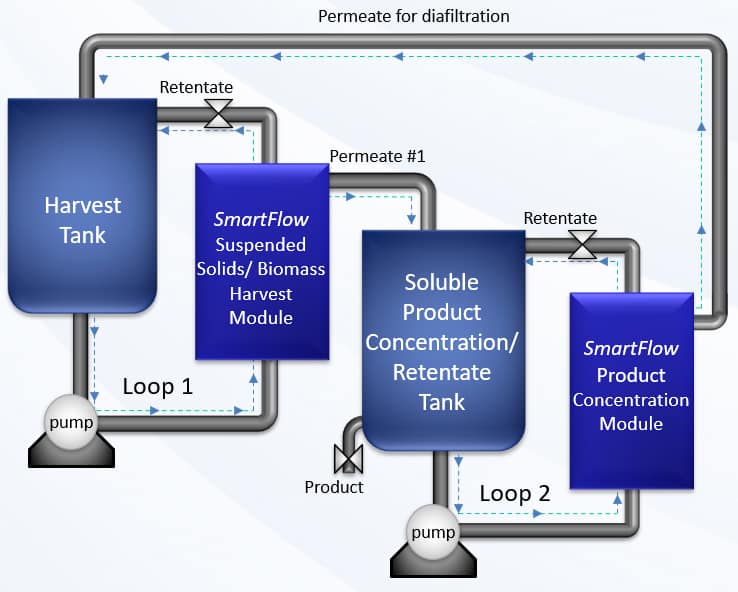
Simultaneous Processing Using a DiaSync® System
Concentration and Process Preparation
What we do: Increase total solids and stabilize product composition for downstream manufacturing, formulation, purification, or drying. Continuous concentration and optional in-line diafiltration minimize hold-up volume and reduce auxiliary tankage. Systems operate efficiently at temperatures up to 85 °C (peak of 90 °C) to improve flux and lower viscosity.
Value to Operations:
- Higher yield. Direct loading and integrated capture/diafiltration minimize product loss, with extracellular recoveries up to ~95 %
- Simplified process and smaller footprint. Combines multiple separation steps into one skid, reducing or eliminating intermediate tankage and transfers
- Consistency through recipe control. Automated parameter control stabilizes operation and offsets day-to-day fermentor variability, maintaining target % solids and quality
- Improved product quality. Achieving higher concentration by membrane separation reduces total heat load on the product. This minimizes protein denaturation and Maillard reactions between residual sugars and amino acids, preserving color, solubility, and flavor integrity
- Energy efficiency when drying or evaporation is used. Higher-solids feeds lower downstream thermal duty; elevated-temperature operation further enhances flux
- Long service life and uptime. Demonstrated continuous operation exceeding 24 months at high temperature, with a multi-year membrane life target

SmartFlow Fermentors
Moving Forward With SmartFlow
So What Does The Process Look Like?
Customer Journey
SmartFlow’s Approach:
The 6-Stage Project Development Program

A structured, low-risk path from goals to full-scale deployment.
The program begins by identifying the goals, defining objectives, and prioritizing opportunities. Feasibility is then verified on actual materials through proof-of-concept testing. From there, SmartFlow develops and optimizes process conditions, membranes, and economics before confirming performance at pilot scale on a right-sized system, supported by SmartFlow’s large rental fleet. The pilot data is used to engineer the plant-scale system(s) with appropriate automation, documentation, and commissioning. Finally, the program standardizes performance across multiple facilities and sustains uptime through ongoing support.
Learn more about the six stages below.