
Unlock Plant Capacity & Drive 45Z Initiatives
Corn Ethanol Stillage Filtration
SmartFlow’s HSTFF™ platform helps corn ethanol producers debottleneck the back end of the plant by removing suspended solids, entrained oil, and excess water earlier in the stillage process.
By sending cleaner, lower-load streams forward, SmartFlow helps reduce pressure on evaporators and dryers, improve coproduct recovery, recover additional corn oil value, and push more gallons through the plant without adding new evaporator or dryer capacity.
For plants evaluating 45Z initiatives, SmartFlow provides a practical bolt-on path to support lower energy intensity, higher throughput, and stronger process efficiency using existing plant infrastructure.
45Z. Capacity. Corn Oil. Lower Energy. One bolt-on stillage upgrade.

Corn Ethanol Stillage Filtration System
What We Help You Achieve
SmartFlow’s HSTFF™ open-channel technology continuously separates suspended solids and emulsified oil at temperatures up to 85 °C (peak of 90 °C) and across a pH range of 1–14.
Deployment Options:
1. Increase Plant Throughput – Debottleneck production by unlocking additional throughput in existing evaporators & dryers
2. Mid-Stillage Clarification (Evaporator Feed) – Relieves evaporator load, improves oil recovery, and reduces dryer fuel demand
3. Backset Clarification (Fermentation Recycle) – Cleans the recycle stream entering fermentation, improving yeast stability and water balance
4. Combined Integration – Provides full-loop solids control for maximum energy efficiency and yield
Where SmartFlow Fits
How SmartFlow Systems Are Deployed
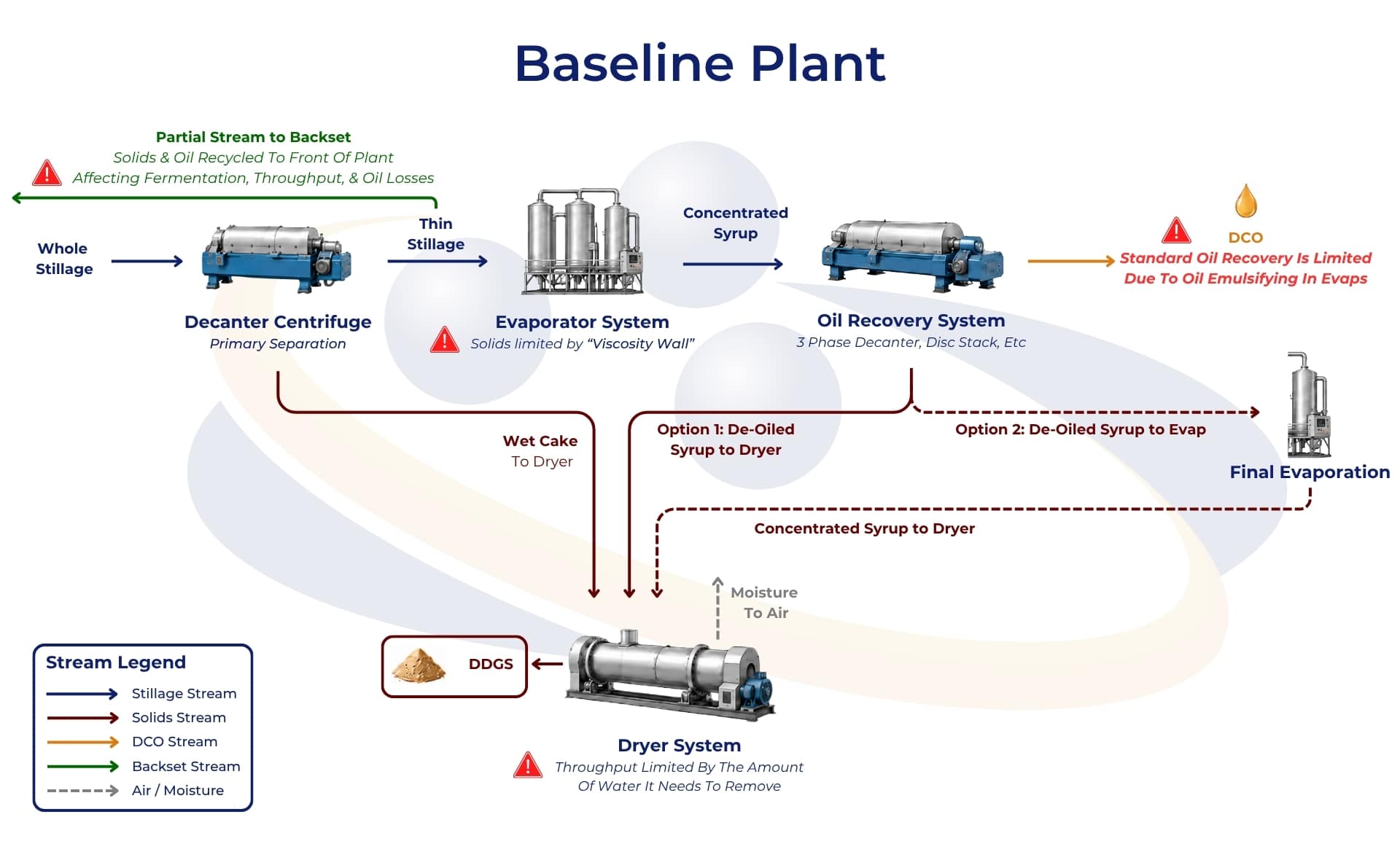
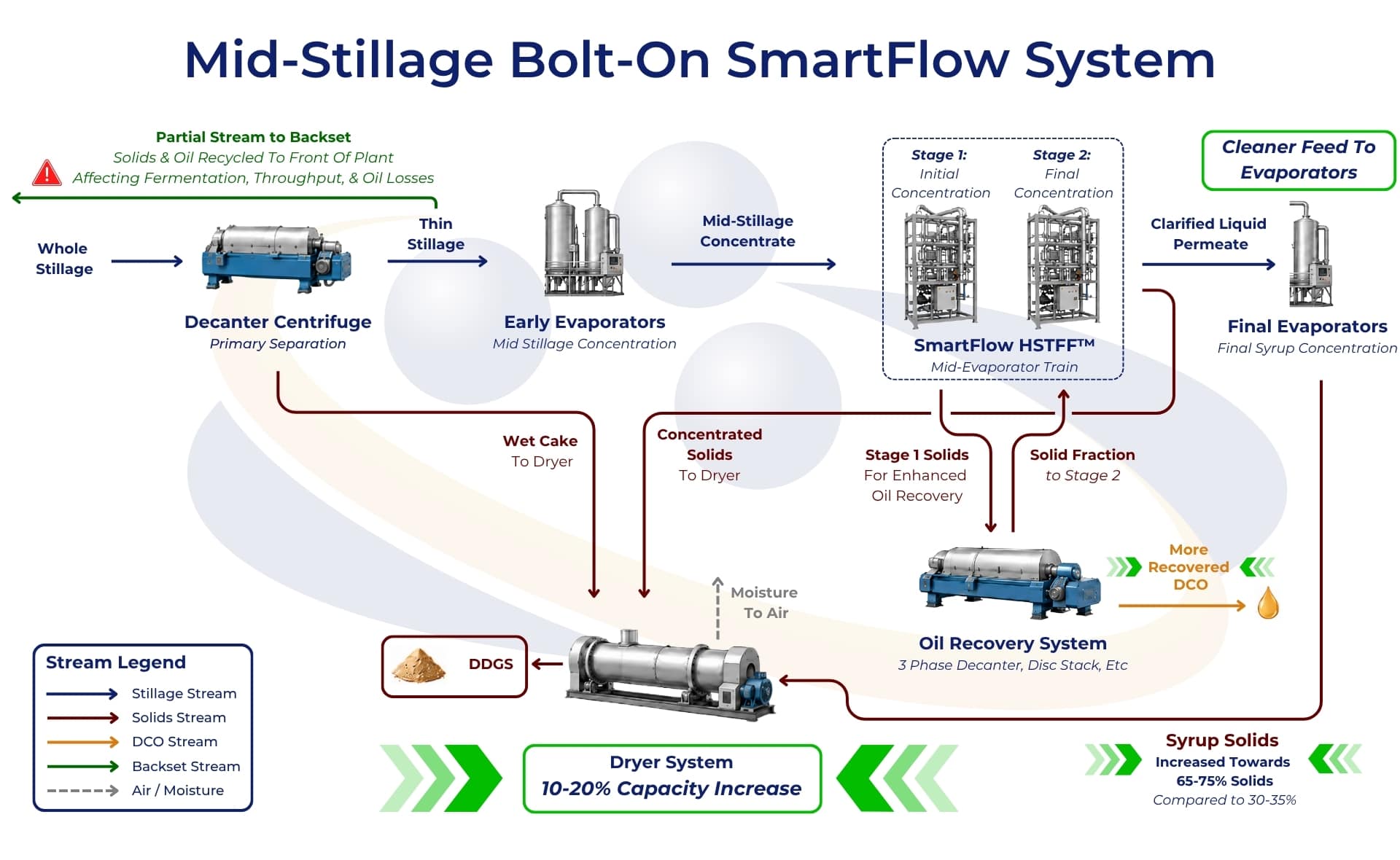
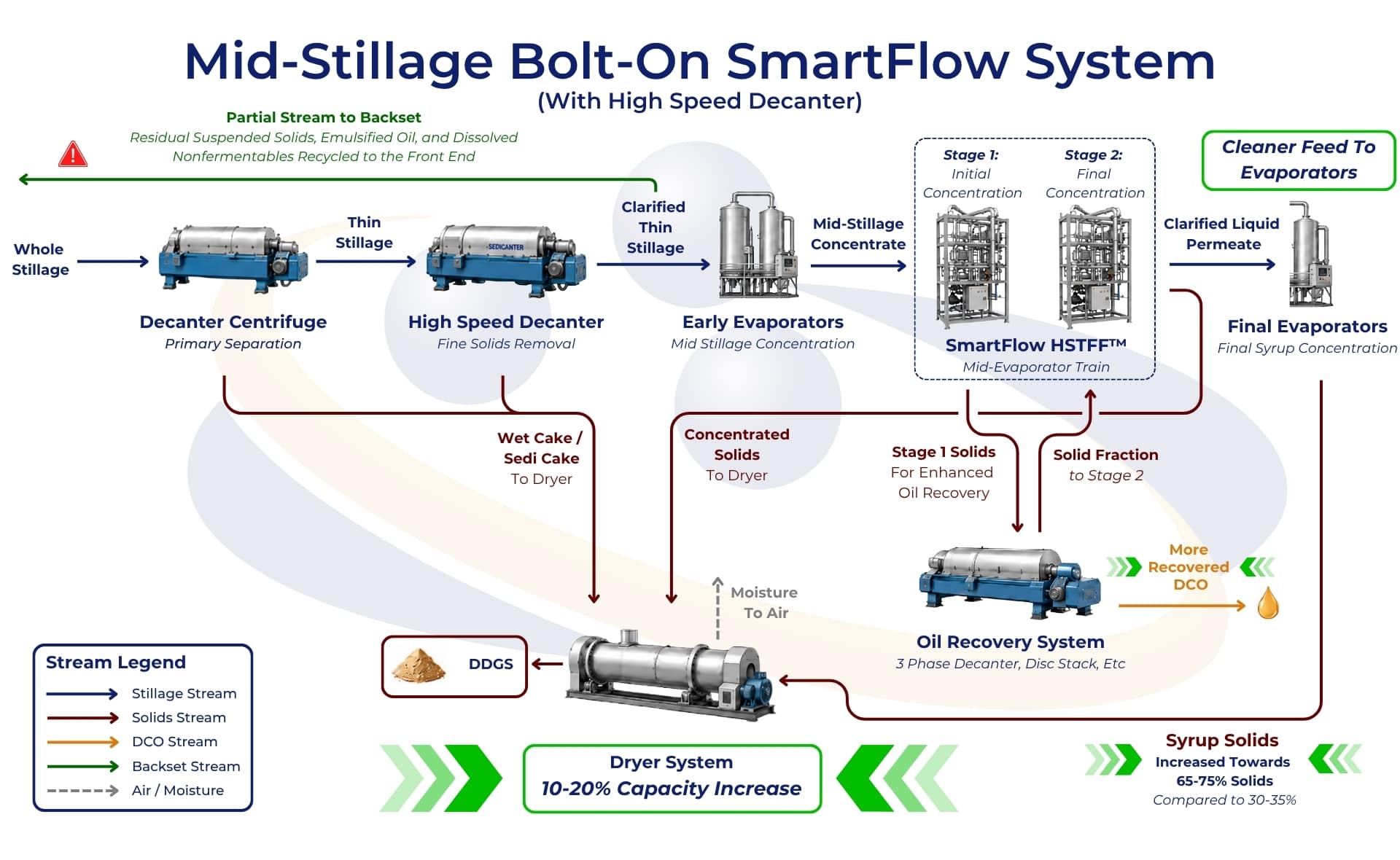
SmartFlow’s HSTFF™ systems can be installed in a variety of applications in Corn Ethanol plants. Below are some of the most common deployments. Click to view how each installation is integrated and to see the benefits for each application.
Impact on Enzyme Performance and Fermentation Stability
As milling and enzyme treatment have improved starch conversion efficiency, particle size in modern ethanol plants has steadily decreased. The resulting fines are often too small to be captured by decanters and remain suspended in the backset. These particles recycle through the fermentors, gradually increasing solids concentration and reducing available fermentation volume.
SmartFlow’s HSTFF™ platform removes the smallest suspended fines before they return to fermentation. This interruption of the solids cycle allows enzymes to be dosed at optimal levels for conversion yield rather than being limited by recirculating solids. The outcome is cleaner fermentation, more stable kinetics, and improved downstream performance in heat exchangers, distillation, and evaporation.

Brochure: HSTFF™ For Stillage Processing
- Applications & Benefits
- Tech Specs
SmartFlow In-Process
Applications
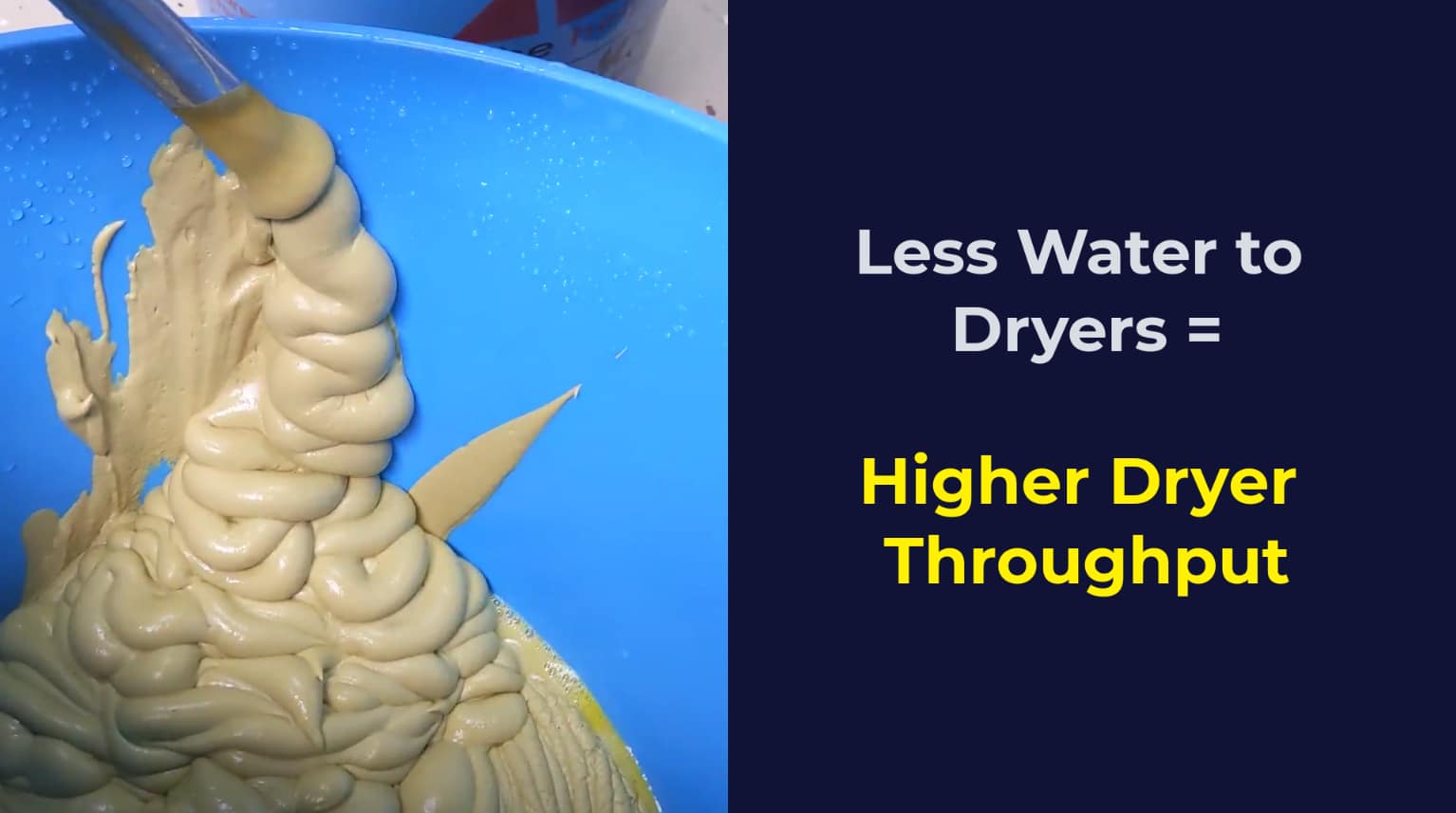
Increase Dryer Throughput Without Adding More Dryers
Objective
SmartFlow HSTFF™ systems remove suspended solids and entrained oil from mid-stillage before final evaporation and drying. By improving flow behavior and reducing viscosity limitations, plants can achieve higher final syrup solids while reducing dryer water load.
The result is increased throughput through existing evaporators and dryers without new equipment capex.
Key Benefits
- Higher Achievable Syrup Solids: Cleaner evaporator feed allows concentration to higher solids before viscosity and flow limitations occur.
- Reduced Dryer Water Load: Less water entering the dryer reduces fuel demand while increasing effective dryer capacity.
- Improved Evaporator Performance: Reduced suspended solids lower fouling tendencies and improve thermal efficiency.
- Increased Plant Throughput: Debottlenecking the dryer and evaporation system allows more product to move through existing infrastructure.

Stillage Concentrate Ready for Drying
Stillage Clarification (Evaporator Feed)
Objective
Remove 100% of suspended solids and entrained oil from the mid-stillage stream, typically withdrawn mid-train, to protect evaporators, improve oil recovery, and reduce dryer load
Process Integration
- HSTFF™ platform operates in parallel with the evaporation circuit
- Clarified permeate returns to the evaporator train; solids/oil concentrate is routed to existing oil recovery
- Fully automated operation with minimal production interruption
Key Benefits
- Targeted Solids & Oil Removal: Captures suspended solids and entrained oil from the evaporator feed loop, protecting downstream effects and improving oil recovery efficiency
- Cleaner Evaporators: Solids-free permeate dramatically lowers fouling and scaling
- Higher Final Concentration: Cleaner feed allows higher solids in the final syrup, reducing dryer load
- Lower Steam Demand: 10–20 % reduction in evaporator steam consumption
- Improved U-Values: Sustains higher heat-transfer coefficients and longer run times
- Compact Footprint: Mid-train draw minimizes membrane area while maintaining full solids removal
Ideal For Plants Seeking:
- Maximum oil yield stability
- Reduced steam and dryer fuel use
- Higher evaporator throughput and uptime

Stillage Concentrate for Dryers (left)
Clarified Stillage for Evaporators (right)
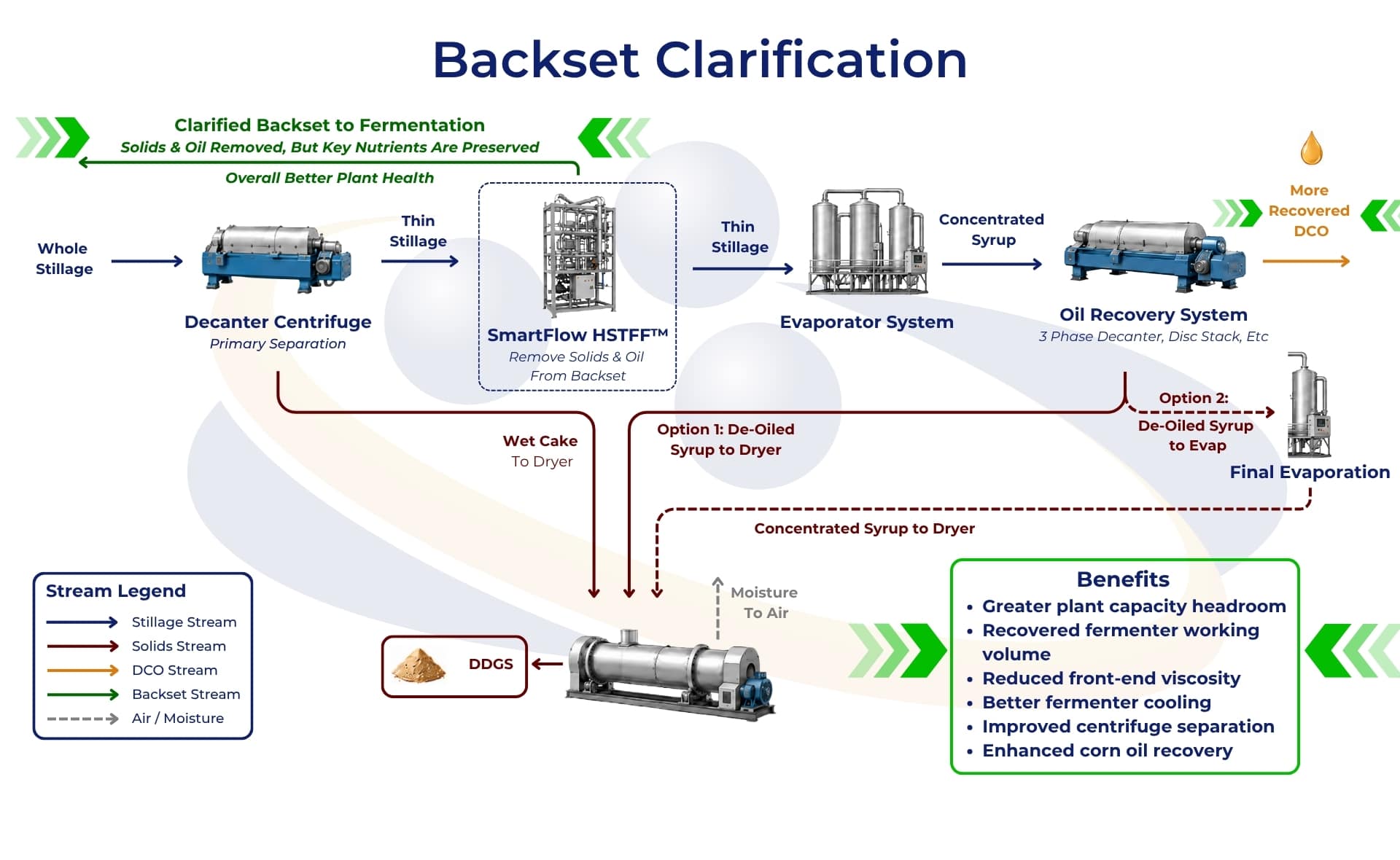
Backset Clarification (Fermentation Recycle)
Objective
Remove suspended solids and emulsified oil from the backset before recycling to fermentation. This results in improved yeast health, heat-transfer performance, and plant-wide water balance.
Process Integration
- HSTFF™ platform ties into the backset loop after evaporation and before mash blending
- Delivers clarified backset suitable for high recycle ratios and consistent fermentation performance
Key Benefits
- Cleaner Fermentation: Removes yeast, fiber, fines, and oil that otherwise accumulate in fermentors
- Improved Yeast Health & Conversion: Reduces non-fermentable load and microbial stress
- Higher Backset Ratios: Cleaner recycle enables greater reuse and reduced freshwater demand
- Enhanced Oil Recovery: Captures oil prior to re-emulsification, stabilizing yield
- Lower System-Wide Solids Load: Reduces fouling in cookers, exchangers, and beer heaters
Ideal For Plants Seeking:
- Stable fermentation and higher ethanol conversion
- Improved water efficiency and closed-loop operation
- More consistent oil yield and easier backset management

Corn Ethanol Stillage Filtration System
Combined HSTFF™ Integration
Objective
Deploy HSTFF™ platform at both the backset and mid-stillage points for full process coverage from fermentation recycle through evaporation.
Key Benefits
- Comprehensive Solids Control: Removes fines and oil from both recycle and evaporation loops
- Synergistic Energy & Yield Gains: Cleaner fermentation and cleaner evaporation compound performance improvements
- Optimized Oil Recovery: Dual-stage separation maximizes oil capture and stability
- Water & Energy Efficiency: Delivers lowest achievable energy intensity and tightest water balance
Ideal For Plants Seeking:
- Balanced performance gains across fermentation, evaporation, and drying
- A scalable platform for future capacity expansion

Thin Stillage Starting, Concentrate, Permeate,
and High Solids (for drying)
Automation, Design, and Retrofit Flexibility
Key Benefits
- Compact Modular Skids: Minimal footprint for retrofit or expansion
- Advanced Automation: Simple operator interface, recipe-based CIP, and integrated performance monitoring
- Scalable Design: Begin with either backset or mid-stillage and expand later for combined operation
- Minimal Downtime Installation: Systems bolt into existing circuits without interrupting production

The SmartFlow Automation Suite
Why Customers Choose SmartFlow
Engineered for Results
- HSTFF™ open-channel technology maintains uniform flow across high-solids, viscous stillage streams
- Optimized shear and channel geometry sustain stable flux under variable loading
- Modular trains enable stepwise expansion with shared automation and components
Designed for Efficiency
- Mechanical dewatering reduces evaporator and dryer energy use
- Clarified permeate improves downstream reliability and strengthens plant water balance through enhanced recycle and reuse capacity
- Integrated process automation ensures simple, repeatable operation
The Result
Cleaner operation, higher yield, lower steam and fuel use, and a scalable path to long-term carbon-intensity (CI) and cost-reduction goals. Whether implemented at the mid-stillage, backset, or both, SmartFlow’s HSTFF™ platform transforms solids management from a maintenance burden into a controllable, high-ROI process variable.

Moving Forward With SmartFlow
So What Does The Process Look Like?
Customer Journey
SmartFlow’s Approach:
The 6-Stage Project Development Program

A structured, low-risk path from goals to full-scale deployment.
The program begins by identifying the goals, defining objectives, and prioritizing opportunities. Feasibility is then verified on actual materials through proof-of-concept testing. From there, SmartFlow develops and optimizes process conditions, membranes, and economics before confirming performance at pilot scale on a right-sized system, supported by SmartFlow’s large rental fleet. The pilot data is used to engineer the plant-scale system(s) with appropriate automation, documentation, and commissioning. Finally, the program standardizes performance across multiple facilities and sustains uptime through ongoing support.
Learn more about the six stages below.