
Our Technology
Smarter Flow. Superior Separation.
SmartFlow Technologies designs filtration systems for the processes that challenge conventional membrane equipment: high solids, elevated viscosity, suspended particles, oil, heat, extreme pH, and other aspects that make continuous production challenging.
Built around SmartFlow’s patented open-channel module architecture, our HSTFF™ (High-Solids Tangential Flow Filtration) technology helps processors remove water, clarify streams, increase dryer/evaporator throughput, recover valuable co-products, and maintain stable operation in applications where traditional spiral-wound systems can become limiting.
Page Section Links

ConSep® II Filter Module
Extending Filtration Performance into High-Solids, High-Viscosity, and High-Temperature Streams
Conventional hollow-fiber, spiral-wound, cassette, and mechanical separation technologies play an important role across process industries. They are well established for many clarification, concentration, and bulk separation applications, especially where streams are lower in solids, lower in viscosity, or well suited to traditional flow geometries.
SmartFlow’s HSTFF™ platform is designed to complement those technologies by extending separation performance into more difficult process conditions. At the center of the platform is the ConSep® II module, an open-channel filter module engineered for viscous, particle-rich, high-solids process streams, including applications operating at temperatures up to 85°C, with a peak of 90°C.
As streams become thicker or more heavily loaded with suspended solids, stable flow across the membrane surface becomes increasingly important. The ConSep® II module uses engineered open-channel flow paths to keep material moving through the module, reduce path-of-least-resistance behavior, and support more consistent membrane surface utilization. This helps SmartFlow maintain repeatable flux, reduce localized fouling tendencies, and support higher-solids operation in streams that may become difficult for conventional filtration systems.
SmartFlow systems can be configured with a range of membrane materials and pore sizes to match the customer’s separation target, chemistry, temperature profile, cleaning requirements, and production goals. The same platform-based approach also supports CIP integration, automated operation, process monitoring, data visibility, alarms, interlocks, and remote support.
Because SmartFlow controls the fluid dynamics inside the module, the HSTFF™ platform is designed to scale out by adding proven membrane area and system capacity rather than relying on a single large scale-up jump. This allows development work using real customer material to move from feasibility testing to pilot confirmation and full production with a more predictable path.
Across dairy, corn ethanol stillage, precision fermentation, food and beverage, and industrial water recovery, SmartFlow helps processors remove more water earlier, increase achievable solids, recover valuable coproducts, and send cleaner streams forward. The result is reduced load on evaporators, dryers, and downstream equipment, with a practical path to improved throughput, more stable operation, and better use of existing plant assets.
SmartFlow’s Technology
How SmartFlow Filter Module Technology Is Different
Conventional hollow-fiber, cassette, and spiral-wound membrane technologies have earned their place across a wide range of separation applications and continue to perform well in many clean, lower-solids, and well-conditioned process streams.
SmartFlow’s HSTFF™ platform was developed to extend membrane performance into more challenging applications where viscosity, suspended solids, particulates, and concentration limits can restrict conventional approaches. At the center of that platform is the ConSep® II module, which uses an open-channel architecture designed to keep difficult process streams moving across the membrane surface without forcing them through narrow, easily obstructed flow paths.
That design difference becomes especially important in high-solids applications such as corn ethanol stillage, dairy powder production, fermentation broths, nutraceuticals, and other viscous or particle-rich streams where maintaining flow, controlling pressure drop, and pushing concentration higher can create significant operational and economic value.
Extending Concentration Beyond Traditional Limits
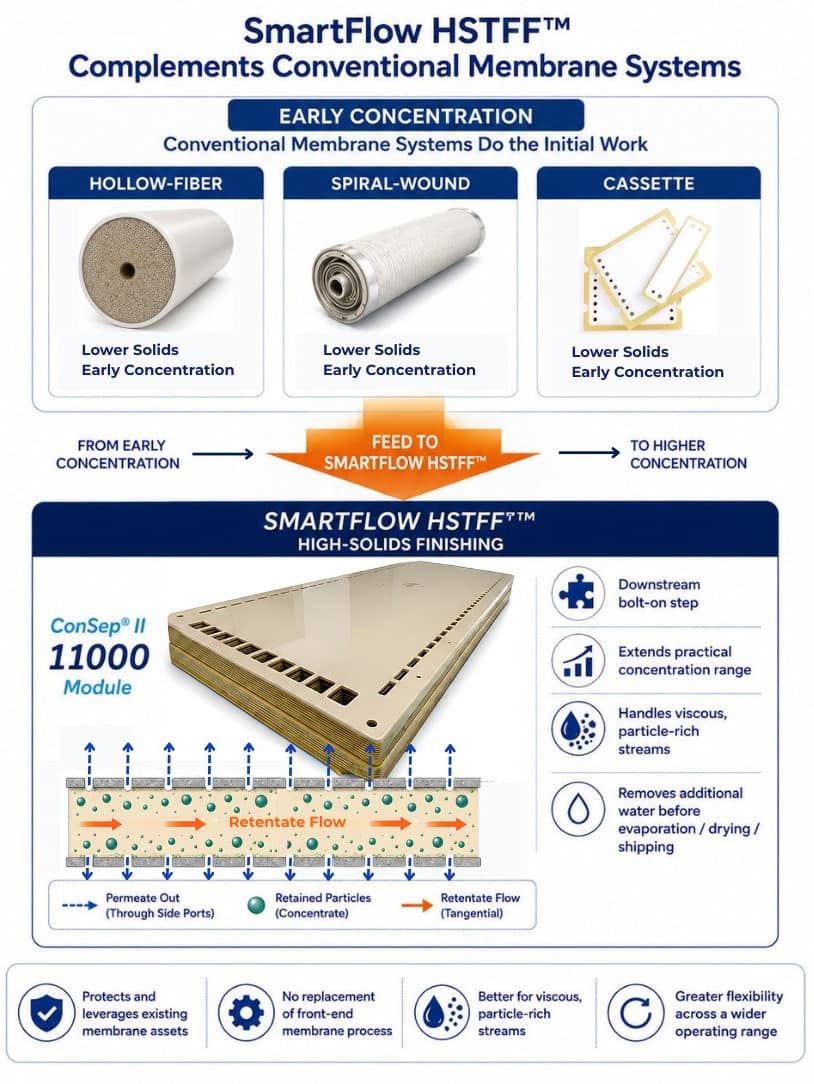
Conventional hollow-fiber, spiral-wound and cassette membrane systems play an important role in many concentration processes and are often well-suited for the early stages, where streams are lower in solids, lower in viscosity, and easier to move through established membrane flow paths.
SmartFlow’s HSTFF™ platform was developed to complement those systems by extending the practical concentration range after conventional membranes have done the initial work. Rather than replacing existing membrane assets, SmartFlow’s HSTFF™ system is typically positioned as a bolt-on high-solids concentration step downstream of existing membrane systems.
This approach allows a plant to continue using its current membrane equipment for initial concentration, then use SmartFlow to take the retentate further by removing additional water before evaporation, drying, shipping, or downstream processing. As solids increase and viscosity becomes more challenging, SmartFlow’s open-channel architecture helps maintain movement across the membrane surface and supports higher-solids operation.
Key Advantages:
- Complements existing hollow-fiber, spiral-wound and cassette membrane systems
- Bolts on downstream to extend concentration beyond current limits
- Helps protect and leverage existing membrane capital investment
- Handles more viscous, particle-rich, and high-solids streams
- Reduces water before dryers, evaporators, shipment, or downstream processing
- Supports higher-solids operation without replacing the front-end membrane process
- Extends the practical operating range of the overall separation system
More Complete Recovery. Fewer Separation Steps
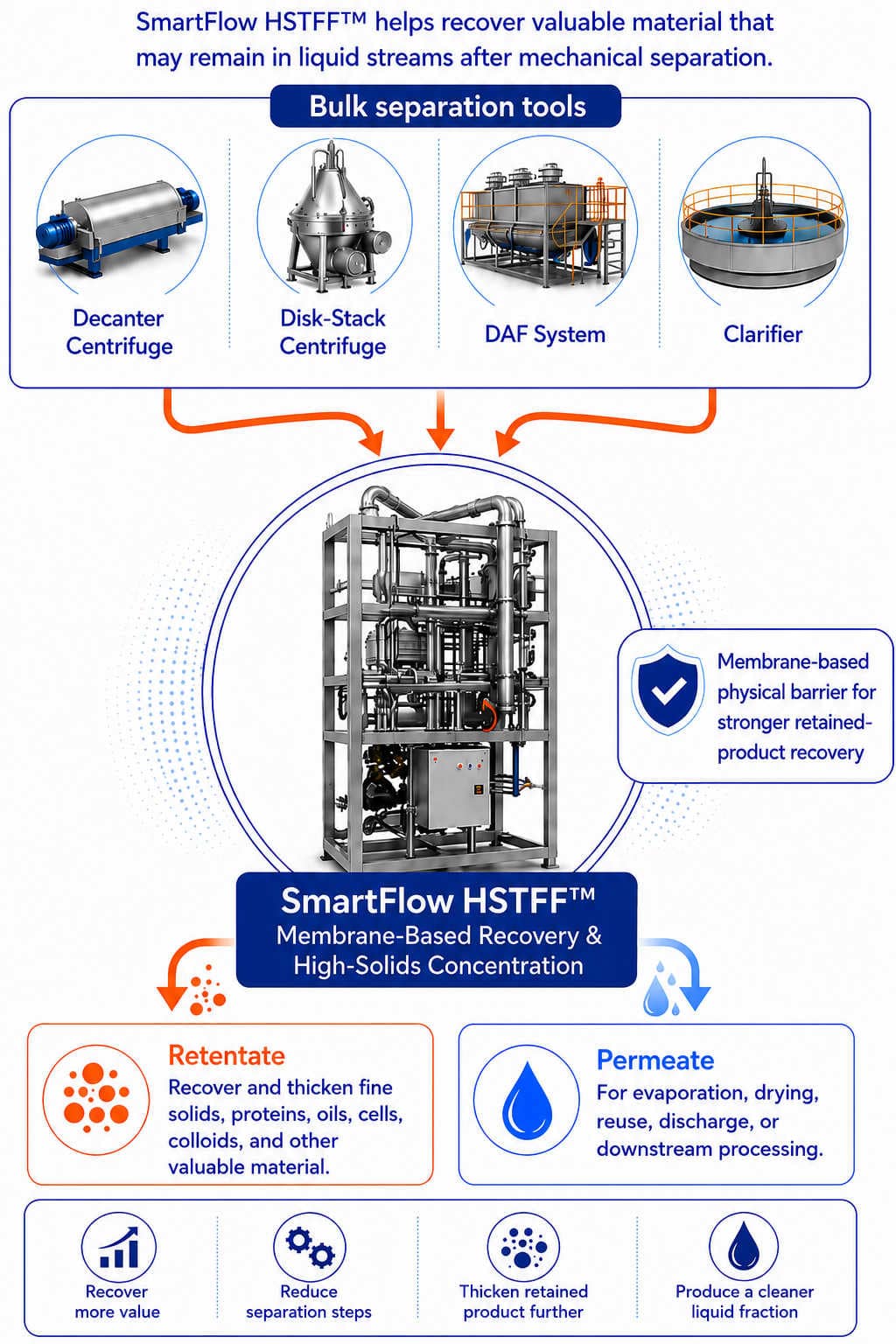
Mechanical separation technologies such as decanter centrifuges, disk-stack centrifuges, DAF systems, and clarifiers are proven tools for bulk separation. They are widely used to remove larger solids, separate phases, reduce suspended load, and prepare streams for downstream processing.
However, mechanical systems depend on how well material responds to force, flotation, settling behavior, particle size, density difference, residence time, and chemical conditioning. In challenging process streams, valuable fine solids, proteins, oils, cells, colloids, or other target materials can remain in the liquid phase and leave with the centrate, overflow, filtrate, or effluent.
SmartFlow’s HSTFF™ platform provides a more defined separation mechanism. The HSTFF™ system uses the ConSep® II module and a membrane as a physical barrier between what is retained and what is allowed to pass. Rather than encouraging valuable material to separate mechanically, SmartFlow retains target material on the product side of the membrane while allowing the liquid fraction to move through as permeate.
That difference creates a stronger yield-recovery position in applications where valuable material is too fine, too slow-settling, too emulsified, too buoyant, too similar in density, or too difficult for mechanical systems to fully capture. Depending on the application, SmartFlow can replace certain mechanical separation steps or be positioned downstream of decanters, disk-stack centrifuges, DAF systems, or clarifiers to recover more value and thicken the retained fraction further.
In some processes, reaching the desired separation or concentration target requires multiple pieces of equipment working in sequence. SmartFlow can simplify that approach by combining clarification, retained-product recovery, and high-solids concentration into a single membrane-based step. This can reduce process complexity, lower handling between unit operations, improve recovery, and create a cleaner liquid fraction for evaporation, drying, reuse, discharge, or downstream processing.
Where mechanical systems remove what can be separated by force, flotation, or settling, SmartFlow is designed to help capture and concentrate what still has value.
Key Advantages:
- Provides a membrane-based physical barrier for stronger retained-product recovery
- Captures fine suspended solids and valuable material that may pass through mechanical systems
- Helps reduce product loss from centrate, overflow, filtrate, or process effluent streams
- Can replace selected centrifuge, DAF, clarification, or polishing steps where membrane separation provides a better process fit
- Can follow decanters, disk-stack centrifuges, DAF systems, and clarifiers to recover additional value
- Can simplify processes that otherwise require multiple separation or thickening steps
- Combines clarification, recovery, and high-solids concentration in a single membrane-based operation
- Thickens retained material beyond what may be practical with mechanical separation alone
- Helps produce cleaner liquid fractions for evaporation, drying, reuse, discharge, or downstream processing
- Supports higher recovery and higher-solids operation without requiring a full process redesign
Turning Higher Solids Concentration into Plant Throughput
SmartFlow’s HSTFF™ platform is not designed to stop at filtration performance. It is designed to create value across the production process by reducing water load, increasing solids, improving stream quality, and helping downstream equipment operate more efficiently.
In dryer-limited processes, every pound of water removed before the dryer can create additional available drying capacity. By concentrating difficult streams to higher solids before drying, SmartFlow can help dairy, precision fermentation, and other processors increase finished product output using existing dryer infrastructure.
In corn ethanol stillage, SmartFlow can help shift the burden away from the evaporators and dryers by removing suspended solids, entrained oil, and water earlier in the process. Cleaner liquid streams can improve evaporator operation by reducing fouling tendencies, lowering viscosity-related limitations, and helping the plant move more water through the system with fewer disruptions. Higher-solids retained fractions can also reduce the load sent forward to thermal equipment.
The result is a practical path to debottlenecking. SmartFlow helps plants push more production through existing assets by reducing thermal load, improving downstream stability, and recovering more value before evaporation, drying, shipping, or further processing.
For ethanol, that can mean improved stillage handling, stronger corn oil and coproduct recovery, cleaner evaporator feed, and more gallons through the plant. For dairy, it can mean higher solids before spray drying and more powder from the same dryer. For precision fermentation, it can mean better recovery, reduced downstream volume, and lower load on concentration, drying, or purification steps.
Where the process bottleneck is water, viscosity, solids handling, or downstream equipment capacity, SmartFlow helps convert separation into production value.
Key Advantages:
- Increases solids before evaporation, drying, shipping, or downstream processing
- Reduces water load on evaporators and dryers
- Helps expand dryer throughput using existing dryer infrastructure
- Sends cleaner liquid streams forward to evaporation or reuse
- Reduces suspended-solids loading, fouling tendencies, and viscosity-related limitations
- Supports more stable evaporator and dryer operation
- Helps ethanol plants improve stillage handling, coproduct recovery, and plant throughput
- Helps dairy processors increase powder production from existing dryers
- Helps precision fermentation processes reduce downstream volume and improve recovery
- Converts filtration and concentration performance into plant-level capacity gains
Engineered Flow Paths for High-Solids Filtration
SmartFlow engineers the HSTFF™ platform around the process stream, not the other way around. The open-channel ConSep® II module gives viscous and particle-rich streams room to move across the membrane surface, so the system can maintain controlled crossflow as solids increase.
SmartFlow configures channel heights to match the viscosity, solids level, and flow behavior of each application. As the stream becomes thicker and more viscous, larger open channels allow the material to continue moving uniformly across the membrane surface.
This design supports stable laminar flow, more complete membrane surface utilization, and consistent crossflow dynamics throughout the module. By controlling the flow path through the module, SmartFlow minimizes dead zones, bypass tendencies, and “path of least resistance” behavior that can lead to plugging, caking, or unstable operation.
The same open-channel design also improves cleanability during CIP by enabling cleaning solutions to move more uniformly through the module. This is a key reason SmartFlow can operate in high-solids applications where conventional filtration equipment may become pressure-limited, flow-limited, or difficult to clean.
Key Advantages:
- Engineers the flow path around the viscosity and solids loading of the process stream
- Uses larger open channels as streams become thicker and more viscous
- Supports stable laminar flow and controlled crossflow across the membrane surface
- Reduces dead zones, bypass flow, plugging, and caking tendencies
- Promotes more complete membrane surface utilization
- Improves cleanability by supporting more uniform CIP flow through the module
- Enables higher-solids filtration in streams that may be difficult for traditional systems
- Helps maintain throughput and separation performance under demanding process conditions

Depiction of the ConSep® II Filter Flow Paths
Engineered Flow Distribution Under High-Solids Load
SmartFlow engineers the ConSep® II module with open channels that distribute process fluid across the membrane surface and keep the active membrane area engaged. The design controls how the stream moves through the module instead of allowing the fluid to favor only the easiest route.
That matters because viscous and particle-rich streams naturally follow the path of least resistance. As viscosity increases and suspended solids build, this problem becomes more severe. In conventional flow geometries, more material can concentrate through the easiest internal routes while lower-flow areas become underutilized, foul faster, or cake over. The result is less effective membrane area, rising pressure drop, unstable flux, shorter production runs, and less predictable scale-up.
SmartFlow’s open-channel architecture is designed to reduce that failure mode. The ConSep® II module maintains more consistent crossflow across the membrane surface, keeping more of the membrane active in the separation process. That stronger flow control supports repeatable flux, more complete membrane utilization, improved cleanability, and a more reliable path from pilot testing to commercial operation.
Key Advantages:
- Distributes process fluid across the active membrane surface
- Reduces path-of-least-resistance flow behavior
- Keeps more membrane area engaged during high-solids operation
- Reduces low-flow zones, localized fouling, and caking tendencies
- Improves flux stability and repeatability
- Extends production time between cleaning cycles
- Improves CIP effectiveness by reducing stagnant areas
- Strengthens scale-up from pilot testing to commercial operation
- Maintains performance in viscous, particle-rich, and high-solids streams

Watch Controlled Flow Distribution in Action
This animation shows how the ConSep® II module uses open-channel flow distribution to keep more of the membrane surface engaged, reduce path-of-least-resistance behavior, and support stable operation as viscosity and suspended solids increase.
Predictable Scale-Out from Testing to Production
SmartFlow scales by controlling the fluid dynamics first, then repeating the proven operating geometry at larger production capacity. Rather than relying on a large “scale-up” jump, the HSTFF™ platform is designed to scale out by adding membrane area, modules, and system capacity while maintaining the same core flow behavior developed during testing.
This matters because difficult streams do not always scale predictably when viscosity, suspended solids, pressure drop, shear, and flow distribution change. SmartFlow’s open-channel HSTFF™ platform and ConSep® II module are engineered to control those fluid-dynamic conditions, allowing results from feasibility testing, process optimization, and pilot confirmation to translate more accurately into commercial operation.
SmartFlow has scaled processes by thousands of times with high accuracy because the system does not depend on guessing how a completely different geometry will behave at full scale. The process is developed using actual customer material, then expanded through a structured, repeatable scale-out approach.

Our 6 Stage Project Development Process starts with defining the customer’s goals, then moves through feasibility testing, membrane selection, operating-condition development, process optimization, pilot confirmation, and full-scale system engineering. Each step builds the data needed to reduce risk before commercial deployment.
The result is a more disciplined path from initial testing to 24/7 production, with a stronger foundation for multi-site deployment once the process is proven.
Key Advantages:
- Develops the process using real customer material
- Controls fluid dynamics before expanding production capacity
- Scales out by adding proven membrane area, modules, and system capacity
- Avoids relying on a single large scale-up jump
- Confirms membrane selection, flow conditions, pressure limits, and operating targets before full-scale deployment
- Supports high-accuracy scale factors measured in thousands of times
- Reduces implementation risk before commercial installation
- Supports repeatable deployment from lab testing to pilot systems to 24/7 production
- Creates a stronger path for multi-facility standardization once the process is proven
Integrated Efficiency for Modern Separation
DiaSync® Diafiltration and Water Recovery
More Recovery. Less Water/Buffer. Higher Final Solids.
DiaSync® is SmartFlow’s integrated approach to diafiltration, concentration, product recovery, and water/buffer reuse. The process is designed to remove permeable impurities or recover soluble product while retaining valuable material with the HSTFF™ platform and ConSep® II module.
Traditional diafiltration often requires large volumes of fresh water/buffer to displace solutes from the retained product phase. That approach works, but it increases permeate volume, wastewater load, utility demand, and downstream processing cost.
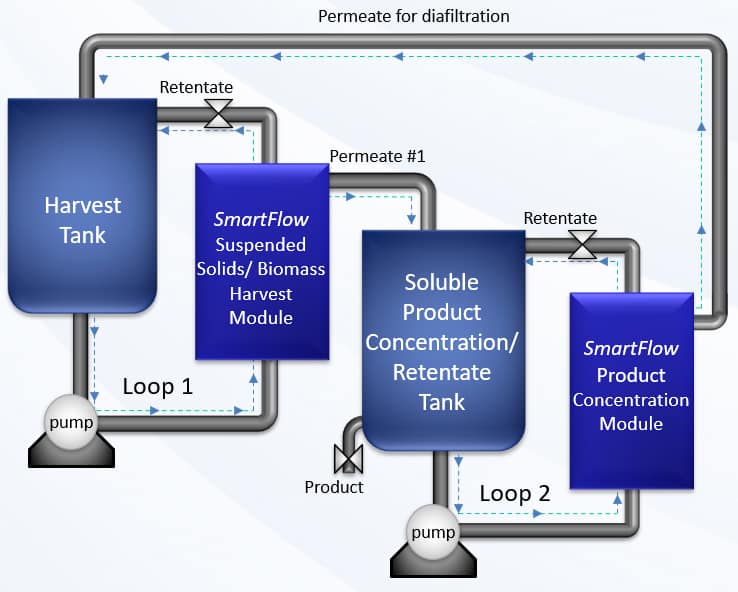
DiaSync® improves that balance by coordinating washing, concentration, permeate recovery, and recycle in one controlled process. In one configuration, the first membrane step retains suspended solids, biomass, cells, or other target material while washing soluble product or permeable components into the permeate. A second membrane step then concentrates that soluble product and returns recovered permeate to the harvest tank for reuse as diafiltration water/buffer.
The HSTFF™ platform makes this approach even more efficient because it can concentrate retained solids to higher levels before or during diafiltration. Higher retained-solids concentration reduces the amount of interstitial liquid trapped around the solids that must be displaced. That means the wash step can focus more directly on recovery and purity instead of spending excess water/buffer moving through unnecessary liquid volume.
DiaSync® also gives the process more recovery time when needed. Extended diafiltration can continue driving soluble product or impurity removal, while the recycle design helps protect recovery. If some valuable material passes through the second concentration step, it is returned to the diafiltration loop rather than being immediately lost from the process, giving the system another opportunity to recover it.
The result is a more efficient path to higher product recovery, improved purity, reduced fresh-water or buffer demand, lower wastewater generation, and higher final concentration.
Key Advantages:
- Fresh-water or buffer consumption can be virtually eliminated in many applications
- Combines diafiltration, concentration, product recovery, and water/buffer reuse
- Allows extended diafiltration time to drive higher recovery or stronger impurity removal
- Recycles recovered permeate back into the wash loop where process chemistry allows
- Helps protect yield when limited product passage occurs in the second concentration step
- Reduces the interstitial liquid volume that must be displaced by concentrating retained solids higher
- Improves recovery efficiency through the high-solids capability of the HSTFF™ platform
- Supports whole-cell, biomass, and suspended-solids concentration to paste-like consistency
- Achieves retained-phase concentrations up to 60–90% wet weight, depending on the material
- Lowers permeate volume, wastewater generation, and downstream utility load
- Reduces energy demand across filtration, evaporation, drying, or downstream processing
Precision Automation. Proven Performance.
The SmartFlow Automation Suite
Integrated Automation & Control
SmartFlow’s Automation Suite manages filtration, diafiltration, and cleaning within a single, unified platform. The system utilizes AllenBradley PLCs and DCS/SCADA architecture with tiered access, providing operators, engineers, and managers visibility and recipe-based sequencing.
Automation Highlights
- Integration into existing site automation and control architectures
- Interfaces with virtually all major control platforms — including Rockwell / Allen-Bradley, Siemens.
- Supports industry-standard communication protocols: Ethernet/IP, Modbus, and OPC-UA
- Enables data exchange and unified plant-wide control
Key Features
- Process-specific, recipe-driven sequencing for filtration, diafiltration, concentration, and CIP
- Adjustable operating setpoints, alarms, interlocks, and control limits
- Continuous process data logging for performance review and troubleshooting
- Remote connectivity options for monitoring, diagnostics, and technical support
- Repeatable operating sequences that reduce operator variation
- Control logic developed using IEC 61131 programming standards
- Scalable automation architecture for pilot, demonstration, and commercial systems

ENGINEERED FOR REAL PROCESS CONDITIONS
Why Customers Choose SmartFlow
SmartFlow delivers process-specific separation performance through a proven HSTFF™ platform, standardized engineering approach, and application-specific configuration. Rather than starting from scratch for every project, SmartFlow uses established module, membrane, automation, testing, and scale-up methods that are adapted to the customer’s material, production goals, operating conditions, and economic targets.
The result is more than a standard filter skid. It is a practical separation system built from proven SmartFlow technology, configured to solve the customer’s specific process challenge without unnecessary complexity.
SmartFlow Advantages:
Proven Platform, Application-Specific Configuration
SmartFlow uses a repeatable engineering platform and configures the system around actual customer materials, separation goals, production requirements, and site conditions.
Open-Channel HSTFF™ Platform
The HSTFF™ platform and ConSep® II module are engineered for viscous, particle-rich, and high-solids streams that can limit conventional membrane systems.
Broad Membrane Flexibility
SmartFlow matches membrane materials and pore sizes to the application, separation target, chemistry, operating conditions, and cleaning requirements without redesigning the entire system.
Structured Scale-Up Path
SmartFlow supports a clear development path from feasibility testing to pilot confirmation to full-scale production deployment, helping reduce uncertainty before commercial installation.
Integrated Automation and CIP
SmartFlow systems use repeatable automation and cleaning strategies designed for recipe-based operation, data visibility, plant integration, and consistent performance.
Production-Focused Outcomes
SmartFlow focuses on measurable operating value: higher throughput, reduced thermal load, cleaner downstream equipment, longer production runs, reduced downtime, and stronger process economics.

Customer Journey
SmartFlow’s Approach:
The 6-Stage Project Development Program

A structured, low-risk path from goals to full-scale deployment.
The program begins by identifying the goals, defining objectives, and prioritizing opportunities. Feasibility is then verified on actual materials through proof-of-concept testing. From there, SmartFlow develops and optimizes process conditions, membranes, and economics before confirming performance at pilot scale on a right-sized system, supported by SmartFlow’s large rental fleet. The pilot data is used to engineer the plant-scale system(s) with appropriate automation, documentation, and commissioning. Finally, the program standardizes performance across multiple facilities and sustains uptime through ongoing support.
Learn more about the six stages below.